“Nebuchadnezzar began speaking and said to them, “Is it true, Shadrach, Meshach, and Abednego, that you do not serve my gods, nor worship the golden statue that I have set up? 15 Now if you are ready, at the moment you hear the sound of the horn, flute, lyre, trigon, psaltery and bagpipe, and all kinds of musical instruments, to fall down and worship the statue that I have made, very well. But if you do not worship, you will immediately be thrown into the midst of a furnace of blazing fire; and what god is there who can rescue you from my hands?”
16 Shadrach, Meshach, and Abednego replied to the king, “Nebuchadnezzar, we are not in need of an answer to give you concerning this matter. 17 If it be so, our God whom we serve is able to rescue us from the furnace of blazing fire; and He will rescue us from your hand, O king. 18 But even if He does not, let it be known to you, O king, that we are not going to serve your gods nor worship the golden statue that you have set up.”
SUGGESTED GUIDELINES FOR YOUR DAILY MEDITATION
Select a block of 30 minutes each day for your meditation with God.
Pray to begin your meditation.
Read and ask general questions about the passage for your own life: (a) What is God telling me? (b) How does God want me to respond to this reading?
Reflect on your life through this passage: (a) Think about your blessings. (b) Think about your journey with God: past, present and future.
Memorize and repeat a word, a phrase, a sentence or verse.
Pray through the passage, or about your thoughts from the passage: (a) Praise God (b) Give thanks (c) Confess your sins (d) Repent of your sins.
“Say to them: ‘As I live,’ says the Lord God, ‘I have no pleasure in the death of the wicked, but that the wicked turn from his way and live. Turn, turn from your evil ways! For why should you die, O house of Israel?’
12 “Therefore you, O son of man, say to the children of your people: ‘The righteousness of the righteous man shall not deliver him in the day of his transgression; as for the wickedness of the wicked, he shall not fall because of it in the day that he turns from his wickedness; nor shall the righteous be able to live because of his righteousness in the day that he sins.’
13 When I say to the righteous that he shall surely live, but he trusts in his own righteousness and commits iniquity, none of his righteous works shall be remembered; but because of the iniquity that he has committed, he shall die. 14
Again, when I say to the wicked, ‘You shall surely die,’ if he turns from his sin and does what is lawful and right, 15 if the wicked restores the pledge, gives back what he has stolen, and walks in the statutes of life without committing iniquity, he shall surely live; he shall not die. 16 None of his sins which he has committed shall be remembered against him; he has done what is lawful and right; he shall surely live. 17 “Yet the children of your people say, ‘The way of the Lord is not [c]fair.’ But it is their way which is not fair!”
SUGGESTED GUIDELINES FOR YOUR DAILY MEDITATION
Select a block of 30 minutes each day for your meditation with God.
Pray to begin your meditation.
Read and ask general questions about the passage for your own life: (a) What is God telling me? (b) How does God want me to respond to this reading?
Reflect on your life through this passage: (a) Think about your blessings. (b) Think about your journey with God: past, present and future.
Memorize and repeat a word, a phrase, a sentence or verse.
Pray through the passage, or about your thoughts from the passage: (a) Praise God (b) Give thanks (c) Confess your sins (d) Repent of your sins.
KEY POINTS: You do not have to go through your consequences hopelessly. God shows us how to hope through our consequences.
In this lesson, God, through Jeremiah councils us to suffering through our consequences hopefully, instead of hopelessly. I encourage you to read the passages and follow along to the audio lesson.
How you process your own thoughts about your past, present and future, and what you do with your conclusions about your past, present and future, will determine if you choose to live through your consequences in hopelessness or choose to live through your consequences in hopefulness.
Below you will find some summary points from the audio lesson.
Psalm 137: 1-2 “By the rivers of Babylon, there we sat down, yea, we wept when we remembered Zion….4 How shall we sing the LORD’s song in a foreign land?”
Lamentations 3:1-18 “My strength and hope have perished from the Lord” I HAVE LOST HOPE.
Lamentations 3:1-19: Accept that you are suffering because of your sins, not because of the sins of the gentiles, not because God is testing you like Abraham and Job, not because you are in the remnant or the resistance.
Lamentations 3:20: Yes, there are good reasons to feel sad, broken, wounded, rejected, ridiculed, afflicted. Your soul should remember the glorious days when you were blessed because:
You worshipped God in spirit and truth.
You strived to live morally upright because of God.
You trusted God above all gods and politics, to provide and to protect you.
Lamentations 3:21-33: but there is a time to remember, confess, to repent and return to God.
There is always time to hope, even while you are living through your consequences. It is not always easy. There is reason, we say that the last thing to die is hope. Because when hope is gone from our hearts, it soon leaves our legs, and we will stop walking towards what we once held as hope.
Lamentations 3:22-25. Even while they were going into captivity, and the smoke was still over Judah, God wanted His people to begin the healing process to return to scriptural worship, scriptural morality and Godly peace and security.
Hope in God alone for physical and spiritual salvation.
Wait on God alone for physical and spiritual salvation.
Seek God alone for physical and spiritual salvation.
Christians are not commanded to worship and live by any law that is found in the Old Testament, unless they are repeated as laws in the Apostles’ Doctrine, found in the pages of the Bible, from Acts chapter two to the Revelation of Jesus Christ.
Lesson 4: The Terms and Conditions of your New Covenant in Christ
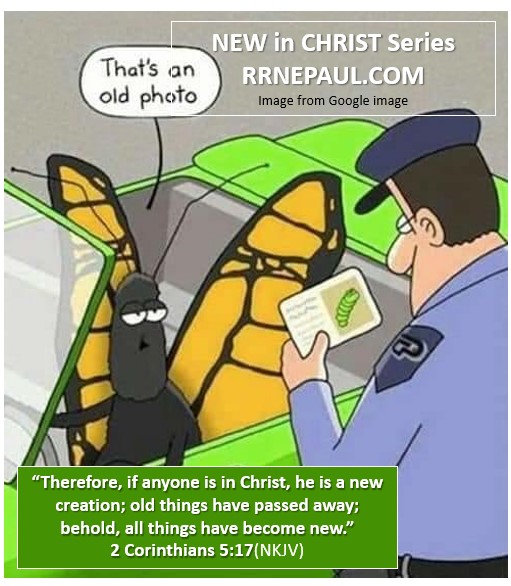
CONGRATULATIONS on becoming a child of God! You have entered into a covenant relationship with God through the blood of Christ.
As Christians, there are a few ways to understand your relationship with God, but the most complete way, is to understand and accept that you are in a covenant relationship with God through Christ. A covenant has three primary parts:
Offer
Terms and conditions
Acceptance
Since most people enter into even the most serious covenant without fully knowing and understanding all the terms and conditions, we reserved our study of the terms and conditions of our covenant with God for lesson four.
So in lesson three, we looked at God’s offer and blessings. In lesson two, we revised what we did to accept God’s offer. And in this lesson , lesson 4, we will begin our study of the terms and conditions of the covenant we have in and with Christ.
Every covenant has terms and conditions, and they are called many things, depending on their purpose. In the Bible, terms and conditions are called laws, and their individual parts are called law, commandment, ordinance, stature, tradition among other titles. But sometimes a single command is called a law.
Laws are not bad, they are not designed to be against you. They are designed to guide you towards the good, keep you on the right path and steer you away from danger.
Well, at least I am certain that the laws of God are as “perfect,” and “sweet” just as David says they are (Psalm 19:7-10). Man’s laws are not always free of bias, they are not always sweet, and perfect. So it is important not to equate God’s laws with the laws of man.
God’s laws are also not from man, but from, well, God Himself. So you really should not try to pick and choose which ones to live and worship by. Because all of God’s laws are a part of scriptures. And even the ones we do not understand or like, are given for our good.
“All Scripture is given by inspiration of God, and is profitable for doctrine, for reproof, for correction, for instruction in righteousness, 17 that the man of God may be complete, thoroughly equipped for every good work.” (2 Timothy 3:16-17).
In later studies, we will talk about what it means to be inspired by God. For now, since you are new in Christ, this lesson assumes that you know enough about the Bible to have accepted it as the word of God. And that God exists, loves you and called you and the whole world to believe, repent, confess and be baptized.
But the Bible has many laws from Genesis to Revelations. And it can get really confusing and contradictory if you try to keep all of them. Getting confused is a good sign that you need to take time to learn the laws of your covenant. Which is why we are having this study, because not all the laws in the Bible are for us today. The Bible is divided into three religious periods:
The Patriarchal Period covers the period from Adam to the day Moses received the Law of Moses from God (Genesis to Moses). It is called Patriarchal, because throughout Genesis, God spoke to various men and women, but most to the head of families like Adam, Enoch, Noah, Abraham, Joseph, and finally Moses (a good summary verse is Hebrews 1:1-2).
The Mosaic Period covers the period from when God gave Moses the law that bears his name, the Law of Moses. (Exodus 19:1-8 to Deuteronomy). This law was given literally and only to the physical nation of Israel. They alone were punished for not keeping it, or blessed for keeping it (Exodus 19:1-5, Exodus 20:1, Deuteronomy 4:1-10; 5:1-5). This law lasted until Jesus came, and ended properly when He rose from the tomb, and the Holy Spirit came in Acts chapter 2. (Luke 16:16–the law and the prophets were until John…”).
The Christian Period. This period started officially when the Holy Spirit came and empowered the Apostles to establish the church, give both the oral and written laws for the church of Christ, and organize the church as a body with leaders and ministries and a system for worshiping God. In other studies, we will take a closer look at the Christian period and the transitions that the Holy Spirit and the Apostles led the church through. The entire world is now living in the Christian Period. And it will last until Jesus returns to Judge the world (Acts 2:17, Hebrews 1:1, 1 Timothy 4:1). See also my book: Shadows of Christianity.
The world should be grateful. Because thanks to Jesus, we do not need to even try and worship or live by the law of Moses, because:
It was never given to all nations. As I pointed out earlier, it was given only to the Jews. This includes even the “Ten Commandments.” Not even Jews need to keep the law of Moses any longer, because it was taken away when that first covenant ended at the cross of Jesus.
The promises that came with the law of Moses were not for all nations.
The new covenant in Christ has its own law, and its own promises and blessings (see lesson 3).
The New law is called among other names, the Apostles’ Doctrine (Acts 2:42). Just like how the law of Moses got its name from the person to whom and through whom God gave it, so it is with the law of the New Covenant. It bears the name of the Apostles, just as it bears the name of Christ (Galatians 6:2).
So where are the laws of Christ or the Apostles’ doctrines found? They are found from The book of Acts 2 to the book of The Revelations of Jesus Christ. Because
That was when the Holy Spirit came and started teaching them what they needed to teach (Matthew 28:19-20).
That was when the Holy Spirit came and started the fulfillment of the promise and prophecy of Jesus (John 16:13).
What about the Gospels of Matthew, Mark, Luke and John? Are they not a part of the Apostles’ Doctrine? Those books are generally called the history of the life of Jesus. As you read them, you will notice that Jesus taught the disciples some things that they would only practice in worship and for salvation, after Acts chapter 2. Things that He would explain to them later after Acts chapter 2, through the Holy Spirit. Things that made no sense to practice before Jesus died and rose again. Because those things were related to his blood, death, burial and resurrection. For example:
Baptism for the remission of sins and to receive the Holy Spirit (John 3:5-8, Matthew 28:19-20). Christian immersion or baptism would not make much sense before the death, burial and resurrection of Jesus, because we are saved by His blood, and baptism represents his blood (Titus 2:5, Hebrews 10:22, Revelations 1:5 his death, burial and resurrection (Romans 6:1-7, 1 Peter 3:21). So when John and later the disciples of Jesus were baptized before He was crucified, it was to prepare people for the real baptism to come. That is why even those who were baptized by John were later baptized to become Christians (Acts 19:1-5).
The Lord’s Supper or Holy Communion. When Jesus had the rehearsal for the Lord’s Supper in Matthew 26:26-28, it would not have made any sense or have any spiritual significance, until after his body was broken by the lashes, punches, thorns, nails, and the spear that was thrust into his side (Matthew 27:27-31, John 19:34). Why? Because the fruit of the vine represents his shed blood and the bread represents his broken flesh or body. But after the Church was established in Acts chapter 2, the Apostles made it apart of the Apostles’ Doctrine to gather on the first day of every week to partake of the Lord’s Supper (Acts 20:7, 1 Corinthians 11:23-26, 1 Corinthians 1:1-2).
As new disciples of Christ, it is important for you to:
Gather with the church, and not just any church, but the Church you were baptized into and added to by Christ (Acts 2:47). So that you can learn how to worship God in spirit and truth, until you enjoy worshiping God the way He commands.
Attend and participate in regular scheduled Bible classes at your congregation of the Lord’s Church, so that you can learn to observe all the things that Jesus taught the Apostles to teach you.
Read Acts to Revelation often, so that you can see how the church lived and worshiped.
Read the Gospels often, so that you can grow in love and faith like Jesus, as you learn about Jesus.
In Lesson 5, we will begin to look at the specific church and worship laws from the Apostles’ Doctrine, the new law of your new covenant in Jesus Christ.
“22 “Throughthe Lord’s mercies, we are not consumed, because His compassions fail not.23 They are new every morning; great is Your faithfulness.24 “The Lord is my portion,” says my soul, “Therefore I hope in Him!”
25 The Lord is good to those who wait for Him, To the soul who seeks Him. 26 It is good that one should hope and wait quietly for the salvation of the Lord. 27 It is good for a man to bear the yoke in his youth.
28 Let him sit alone and keep silent, because God has laid it on him; 29 Let him put his mouth in the dust— There may yet be hope. 30 Let him give his cheek to the one who strikes him, and be full of reproach.
31 For the Lord will not cast off forever. 32 Though He causes grief, yet He will show compassion according to the multitude of His mercies. 33 For He does not afflict willingly, nor grieve the children of men.”
SUGGESTED GUIDELINES FOR YOUR DAILY MEDITATION
Select a block of 30 minutes each day for your meditation with God.
Pray to begin your meditation.
Read and ask general questions about the passage for your own life: (a) What is God telling me? (b) How does God want me to respond to this reading?
Reflect on your life through this passage: (a) Think about your blessings. (b) Think about your journey with God: past, present and future.
Memorize and repeat a word, a phrase, a sentence or verse.
Pray through the passage, or about your thoughts from the passage: (a) Praise God (b) Give thanks (c) Confess your sins (d) Repent of your sins.
“The word which came to Jeremiah from the Lord, saying: 2 “Arise and go down to the potter’s house, and there I will cause you to hear My words.” 3 Then I went down to the potter’s house, and there he was, making something at the wheel. 4 And the vessel that he made of clay was marred in the hand of the potter; so he made it again into another vessel, as it seemed good to the potter to make. 5 Then the word of the Lord came to me, saying: 6 “O house of Israel, can I not do with you as this potter?” says the Lord. “Look, as the clay is in the potter’s hand, so are you in My hand, O house of Israel! 7 The instant I speak concerning a nation and concerning a kingdom, to pluck up, to pull down, and to destroy it,8 if that nation against whom I have spoken turns from its evil, I will relent of the disaster that I thought to bring upon it. 9 And the instant I speak concerning a nation and concerning a kingdom, to build and to plant it,10 if it does evil in My sight so that it does not obey My voice, then I will relent concerning the good with which I said I would benefit it.11 “Now therefore, speak to the men of Judah and to the inhabitants of Jerusalem, saying, ‘Thus says the Lord: “Behold, I am fashioning a disaster and devising a plan against you. Return now everyone from his evil way and make your ways and your doings good.” 12 And they said, “That is hopeless! So we will walk according to our own plans, and we will everyone obey the dictates of his evil heart.”
SUGGESTED GUIDELINES FOR YOUR DAILY MEDITATION
Select a block of 30 minutes each day for your meditation with God.
Pray to begin your meditation.
Read and ask general questions about the passage for your own life: (a) What is God telling me? (b) How does God want me to respond to this reading?
Reflect on your life through this passage: (a) Think about your blessings. (b) Think about your journey with God: past, present and future.
Memorize and repeat a word, a phrase, a sentence or verse.
Pray through the passage, or about your thoughts from the passage: (a) Praise God (b) Give thanks (c) Confess your sins (d) Repent of your sins.
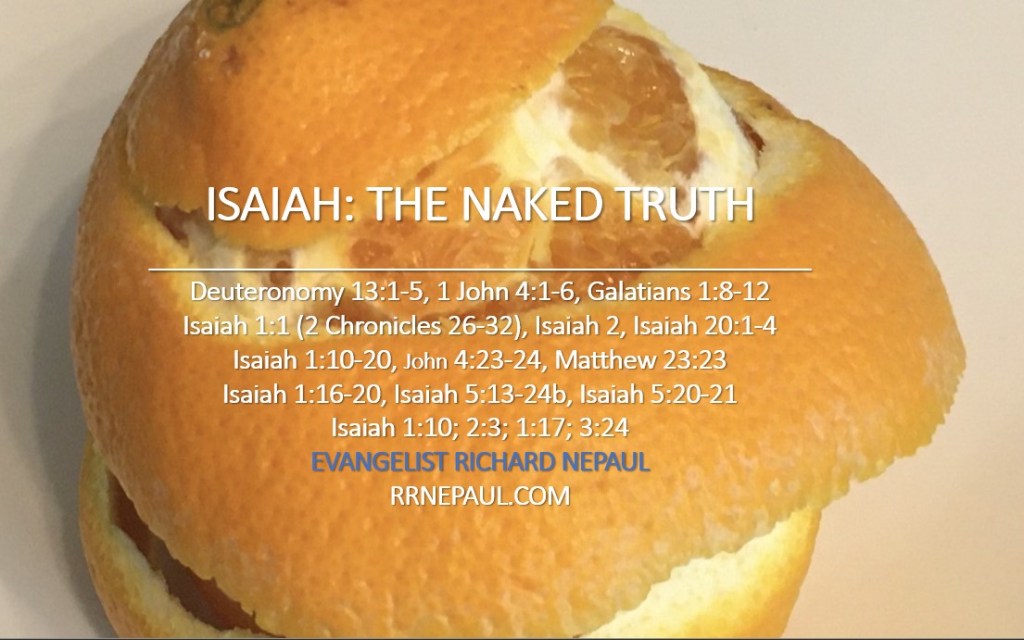
KEY QUESTION: Are you calling good evil and evil good in worship and in your daily life?
In this lesson, God, through Isaiah the prophet, calls us to consider how we feel, think and act about worship and our daily lives. I encourage you to read the passages and follow along to the audio lesson.
2 Peter 1:20-21, Deuteronomy 13:1-5, 1 John 4:1-6, Galatians 1:8-12
2 Peter 1:20-21: All Scriptures come to us from God. And in both the old and New Covenant, God values His words over the tricks and assumptions of men.
This year (2023) the world population is estmated to be 8 billion. How many people either do not beleive that God came in the flesh (John 1), and is the last Messiah (Christ)? Not trillions (obviously), but billions. And how many churches in Christianity are actually teaching and practicing in worship and life what the Apostles taught (Acts 2:42, 1 John 4:6)? Perhaps millions, if not billions also. DO NOT BE ONE OF THEM.
Not all kings were bad or good, just as how not all leaders and teachers are all bad or all good. We must all learn from the bad examples, and follow the good examples.
Isaiah 1:10-20, John 4:23-24, Matthew 23:23
Holiness is more than being a “good” moral upright person. Worshiping as God commands is just as important. And what you beleive and practice as religion is very important to you salvation. Are you really worshipping in “spirit and truth”?
Isaiah 1:16-20, Isaiah 5:13-24b, Isaiah 5:20-21
In your daily life and worship, are you calling bad good and good bad?
Isaiah 1:10; 2:3; 1:17; 3:24
Open your Bible, read, meditate and accept the commandments and blessings of God. DO not be like those who reject God’s words, and allow society, culture and false teachers to tell them what is good and bad.
May God bless you and you strive to return to God by returning to the Bible.
If this lesson and this website is of help to you, please remember to subscribe to rrnepaul.com for more updates. And please share this site with others who may find it useful also. I also welcome your comments.
13 Therefore my people go into exile for lack of knowledge; their honored men go hungry, and their multitude is parched with thirst.
14 Therefore Sheol has enlarged its appetite and opened its mouth beyond measure, and the nobility of Jerusalem and her multitude will go down, her revelers and he who exults in her.
15 Man is humbled, and each one is brought low, and the eyes of the haughty are brought low.
16 But the LORD of hosts is exalted in justice, and the Holy God shows himself holy in righteousness.
17 Then shall the lambs graze as in their pasture, and nomads shall eat among the ruins of the rich.
18 Woe to those who draw iniquity with cords of falsehood, who draw sin as with cart ropes,
19 who say: “Let him be quick, let him speed his work that we may see it; let the counsel of the Holy One of Israel draw near, and let it come, that we may know it!”
20 Woe to those who call evil good and good evil, who put darkness for light and light for darkness, who put bitter for sweet and sweet for bitter!
21 Woe to those who are wise in their own eyes, and shrewd in their own sight!
22 Woe to those who are heroes at drinking wine, and valiant men in mixing strong drink,
23 who acquit the guilty for a bribe, and deprive the innocent of his right!
24 Therefore, as the tongue of fire devours the stubble, and as dry grass sinks down in the flame, so their root will be as rottenness, and their blossom go up like dust; for they have rejected the law of the LORD of hosts, and have despised the word of the Holy One of Israel.
30 MINUTES with GOD: Suggested Guidelines for your Daily Meditation
Select a block of 30 minutes each day for your meditation with God.
Pray to begin your meditation.
Read and ask general questions about the passage for your own life: (a) What is God telling me? (b) How does God want me to respond to this reading?
Reflect on your life through this passage: (a) Think about your blessings. (b) Think about your journey with God: past, present and future.
Memorize and repeat a word, a phrase, a sentence or verse.
Pray through the passage, or about your thoughts from the passage: (a) Praise God (b) Give thanks (c) Confess your sins (d) Repent of your sins.
“10 And the Lord restored Job’s losses when he prayed for his friends. Indeed, the Lord gave Job twice as much as he had before. 11 Then all his brothers, all his sisters, and all those who had been his acquaintances before, came to him and ate food with him in his house; and they consoled him and comforted him for all the adversity that the Lord had brought upon him. Each one gave him a piece of silver and each a ring of gold. 12 Now the Lord blessed the latter days of Job more than his beginning; for he had fourteen thousand sheep, six thousand camels, one thousand yoke of oxen, and one thousand female donkeys. 13 He also had seven sons and three daughters.” (NKJV)
30 MINUTES with GOD: Suggested Guidelines for your Daily Meditation
select a block of 30 minutes each day for your meditation with God.
Pray to begin your meditation.
Read and ask general questions about the passage for your own life: (a) What is God telling me? (b) How does God want me to respond to this reading?
Reflect on your life through this passage: (a) Think about your blessings. (b) Think about your journey with God: past, present and future.
Memorize and repeat a word, a phrase, a sentence or verse.
Pray through the passage, or about your thoughts from the passage: (a) Praise God (b) Give thanks (c) Confess your sins (d) Repent of your sins.
Did you know that you are in a covenant relationship with Christ? Below is the complete written lesson. The audio is in 3 parts.
LISTEN – PART 1 OF 3LISTEN – PART 2 OF 3LISTEN – PART 3 OF 3
Lesson 3: Your New Covenant in Christ
CONGRATULATIONS on becoming a child of God! You have entered into a covenant relationship with God through the blood of Christ.
Matthew 26:28“For this is My blood of the new covenant, which is shed for many for the remission of sins.”
A covenant is an agreement between a person and God, or between people, which requires binding actions from one party to the other. These binding actions are usually called “terms and conditions.” A covenant has three parts:
offer,
terms and conditions,
and acceptance. The acceptance of the offer is then ratified, or sealed, and is considered to be a big part of the acceptance.
A covenant is made between a higher and a lower ranked person or being. In this sense, a covenant is a higher form than a contract, since a contract is made between equal parties. For example, a job contract between humans, a marriage contract, or even an unofficial friendship contract.
In the case of a covenant, the higher party invites the lower party into a covenant relationship, and then both parties agree that it is a beneficial agreement, especially for the lower party. For example, a king goes into a covenant as the higher party of power over his subjects.
In the case of your covenant agreement with God, God is obviously the higher and highest party there is, and He invites us into a covenant agreement with Him. We all have the choice to say no. But as soon as we realized that our lives would be empty and meaningless without God, and we recognized the great blessings of His gracious offer, and yes, the consequences of saying no, we gladly said YES!
Let us now take a brief look at the offer of salvation and some of the blessings of the covenant relationship with God.
GOD INVITED you into a covenant relationship:
When He died for us. Romans 5:8: “But God demonstrates His own love toward us, in that while we were still sinners, Christ died for us.” God invited the whole world into a covenant relationship with Him, when He made the first move. He came in the flesh and died for the world. Most people are familiar with John 3:16, but Romans 5 describes God’s love so much more.
When he said come. Matthew 11:28: “Come to Me, all you who labor and are heavy laden, and I will give you rest.”
YOU ACCEPTED God’s offer. This offer helped you to see your unsaved condition, because you were not in a covenant relationship with God. So you accepted His offer, and became saved by His blood, as these passages reminds us:
Offer and consideration: Acts 2:36: “Therefore let all the house of Israel know assuredly that God has made this Jesus, whom you crucified, both Lord and Christ.”
Evaluating the value of the offer: Acts 2:37“Now when they heard this, they were cut to the heart, and said to Peter and the rest of the apostles, “Men and brethren, what shall we do?”
Accepting the offer: Acts 2:38 “Then Peter said to them, “Repent, and let every one of you be baptized in the name of Jesus Christ for the remission of sins; and you shall receive the gift of the Holy Spirit.”
In many other Bible passages, we are reminded of the wonderful love of God and the reasons why you accepted the offer to enter into a covenant relationship with Christ. Take a look at two of passages.
Romans 8:9“Much more then, having now been justified by His blood, we shall be saved from wrath through Him.”
Revelation 1:5: “and from Jesus Christ, the faithful witness, the firstborn from the dead, and the ruler over the kings of the earth. To Him who loved us and washed us from our sins in His own blood.”
The Consideration of your covenant with God. The Bible refers to these considerations as blessings. The blessings of your covenant relationship with God in Christ, does not come only after you die. But there are many blessings to enjoy and appreciate now, while you live on earth. For we are told that
“…Godliness is profitable for all things, having a promise of the life that now is and of that which is to come” (1 Timothy 4:8).
Let us look at some of the blessings that you are already experiencing and can look forward to in your new covenant relationship with Christ, through the Church.
BLESSINGS NOW:
The blessing of peace. As you grow in your Christian faith, you will experience the blessing of peace that is beyond human understanding, but within human experience. Phil. 4:6-7“Be anxious for nothing, but in everything by prayer and supplication, with thanksgiving, let your requests be made known to God; 7and the peace of God, which surpasses all understanding, will guard your hearts and minds through Christ Jesus.” This is important, because the world can make us anxious about a lot of things like safety, relationships and even about the basic necessities of life.
The blessing of love. As you grow in your Christian faith, you will experience the blessing of love that is beyond human understanding, but within human experience. Eph. 3:17-19“That Christ may dwell in your hearts through faith; that you, being rooted and grounded in love, may be able to comprehend with all the saints what is the width and length and depth and height— 19to know the love of Christ which passes knowledge; that you may be filled with all the fullness of God.”
The blessing of the Holy Spirit. As you grow in your Christian faith, you will experience the blessing of having the Holy Spirit to help you in your communication with God. This is another blessing that is beyond human understanding, but within human experience. Romans 8: 26-27. “Likewise the Spirit also helps in our weaknesses. For we do not know what we should pray for as we ought, but the Spirit Himself makes intercession for us with groanings which cannot be uttered. 27 Now He who searches the hearts knows what the mind of the Spirit is, because He makes intercession for the saints according to the will of God.”
The blessing of God providing for your daily needs.Philippians 4:19“And my God shall supply all your need according to His riches in glory by Christ Jesus.” In the more familiar verse, Matthew 6:33 Jesus says, “But seek first the kingdom of God and His righteousness, and all these things shall be added to you.” All these things are food, clothing and shelter, and peace of mind. Jesus says, as long as you strive to do the righteous things and you are putting the commandments and obligations of His kingdom first, you will never have to worry about your needs been supplied. Grow to trust Him.
The blessing of the forgiveness of your sins. 1 John 1:9“If we confess our sins, He is faithful and just to forgive us our sins and to cleanse us from all unrighteousness.”
The blessing of the church family. Ephesians 3:21“To Him be glory in the church by Christ Jesus to all generations forever and ever, Amen.” Notice that even the blessing that we spoke about earlier, the blessing of God’s love, is now to those who are in the church family. In verse 14-15, we are told that the “whole family in heaven and earth is named,” after Jesus Christ. Take some time to read Ephesians chapter 1, it tells us about some of our blessings in Christ, through the church.
There are countless blessings that you will experience in your covenant relationship with Jesus, and all of them are only to those who are in Christ. And those who are in Christ, are baptized into the church, the body of Christ.
Eph. 5:26-27– “that He might sanctify and cleanse her with the washing of water by the word, 27 that He might present her to Himself a glorious church, not having spot or wrinkle or any such thing, but that she should be holy and without blemish.”
You will realize as you read those verses, that Jesus emphasizes that His blessings will go to those who are:
washed by His blood,
to those who are in the church and
to those who remain faithful.
All three are related. When you are
washed by the blood through water and the Spirit by immersion in water (Acts 2:38, John 3:5),
you are added to the church (Acts 2:47 says, “Praising God and having favor with all the people. And the Lord added to the church daily those who were being saved.”
And Christ expects and commands you to maintain an active relationship with the church, especially at the congregational level, so that you can grow into the fellowship by receiving and sharing.
And so that you can help others as they help you to remain faithful to the end (Rev. 2:10b– “…Be faithful until death, and I will give you the crown of life.”
And in doing all of those things, you will glorify God through the church as a member. 1 Peter 2:4 & 9 says “You also, as living stones, are being built up a spiritual house, a holy priesthood, to offer up spiritual sacrifices acceptable to God through Jesus Christ. 9. But you are a chosen generation, a royal priesthood, a holy nation, His own special people, that you may proclaim the praises of Him who called you out of darkness into His marvelous light;”
It is not always comfortable meeting and getting familiar with a group of people. But as you become more a part of the body of believers in your local congregation, by worshipping, participating in classes and in active life ministries, you will sooner than later, become at easy with your new family in Christ.
BLESSINGS AFTER NOW, IN HEAVEN. There is one big blessing after this life is over, and I anticipate that it will be filled with countless blessings also. This is our inheritance in heaven. After you have lived faithfully to God on earth, you will receive the ultimate blessing of eternal life with God in heaven. This blessing, even more than peace and love on earth in Christ, is beyond our human understanding. It is definitely beyond our present human experience. This blessing requires more of your faith than any other part of your covenant relationship with Jesus, because only Christ has been there and back.
John 1:18– “No one has seen God at any time. The only begotten Son, who is in the bosom of the Father, He has declared Him.”
Heaven is as real as God and the world He created. You can take comfort in faith, that heaven is as real as Jesus was and is real. John 14:1-3“Let not your heart be troubled; you believe in God, believe also in Me. 2 In My Father’s house are many mansions; if it were not so, I would have told you. I am going to prepare a place for you. 3 And if I go and prepare a place for you, I will come again and receive you to Myself; that where I am, there you may be also.”
In Hebrews 11:3, we are reminded that “By faith we understand that the worlds were framed by the word of God, so that the things which are seen were not made of things which are visible.” So yes, there are many things that you will not be able to experience and prove, but because of the other things of God that you can experience and prove, you can know that God is real, and heaven where is dwells, is also real.
No one can understand or fully explain heaven. Take comfort in faith, that not even the Apostle John fully understood what the blessings will be like in heaven. He says in 1 John 3:2“Beloved, now we are children of God; and it has not yet been revealed what we shall be, but we know that when He is revealed, we shall be like Him, for we shall see Him as He is.”
Your new covenant relationship with Jesus is indeed special, filled with many blessings. But like all covenant relationships, it also has obligations.
Rember the second part of a covenant, the “terms and conditions”? They are just as real as God, the earth and heaven, and how you keep to your side of the agreement will literally determine how God keeps his side.
But these obligations should not be seen as negatives. They are there to help you experience and obtain all the blessings of your covenant relationship with the God who loves you and died for you.
In our next lesson, we will talk about the obligations of your New Covenant relationship with God, which are written in the law of your New Covenant with God.
Remember to share this lesson with a friend and subscribe and sign up so that you can receive a notice by email, when the next lesson is posted.
Please join us next time. May God bless you as you continue to grow in Christ.
 RICHARD NEPAUL